Awareness · August 1, 2026
The “Rolling Teacher” Takes the Lead
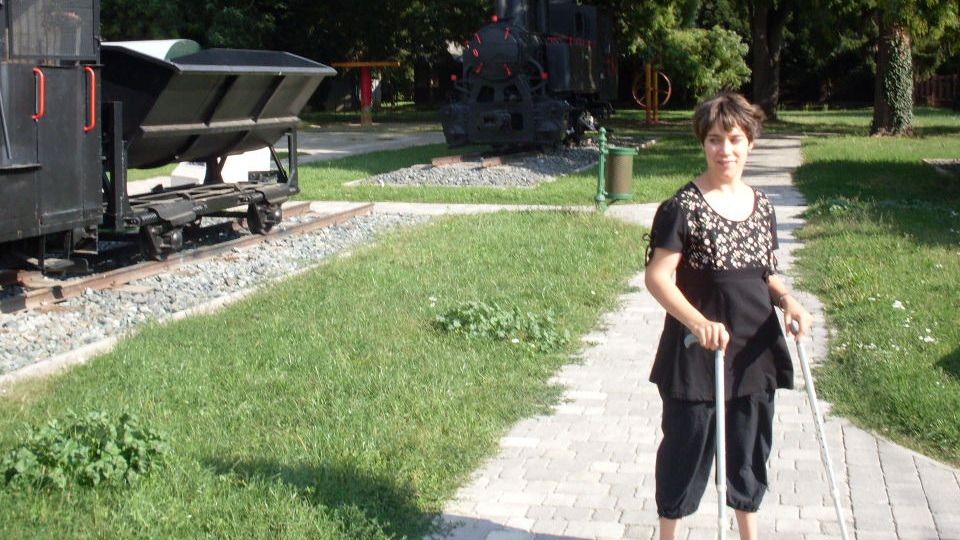
Mária, our newest volunteer, was diagnosed in infancy with what was then called Little's disease — known today as cerebral palsy (CP). In many ways, Mária has been a trailblazer: she attended mainstream schools alongside non-disabled children her whole life, she was the only student with a physical disability to complete the library science and Hungarian literature program at her college's faculty of education, and she even went to freshman camp to prove that a full life is possible this way too. We sat down with the “rolling teacher” to talk about what it was like growing up with CP in the 1990s and what challenges she faces in everyday life.
When did your parents realize that movement would be harder for you than for others?
F.M.: I wasn't moving the way an infant my age should, so my parents took me to the developmental neurology clinic in Pécs when I was 9 months old. The medical diagnosis there was a severe motor and cognitive impairment — even though I had been discharged from the maternity ward in Pécs as a healthy baby, simply born premature. After that, we attended the pediatric neurology clinic in Szekszárd until I was 2, and then I was referred to the Pető Institute (ed.: an institution dedicated to the rehabilitation of people with motor disabilities). That's where we received the final diagnosis: spastic diplegia, combined with severe Little's disease.
How well known was this condition in Hungary in the 1980s — then called Little's disease, today cerebral palsy?
F.M.: I wouldn't say it was completely unknown, but people didn't really understand it. The health visitor and the doctors reassured my parents that I would catch up with my peers in time. They said that the proverbial thread holding me back from stepping and walking would snap one day, and I'd be able to walk on my own. The developmental neurologist was the first to notice that something was wrong.
Once my parents learned the diagnosis, we went regularly to the Pető Institute for movement therapy as an outpatient — at first every six weeks, later every three months — until I was 13 or 14. I wasn't a boarder, and my parents didn't want me to be. Then we found a kindergarten relatively close to us, where a wonderful conductor worked with me. Thanks to her exercises, my movement improved dramatically: she was the first to teach me to walk, first with two tripod canes, then with two single-point canes — and by the time I started primary school, I had switched to two single-point canes.
Did you face any disadvantage in primary school because of your physical disability?
F.M.: My parents did everything — and still do to this day — so that I could take part in everything the other children did. Whether it was a kindergarten or school trip or any community program, I never felt left out. The only negative was the occasional teasing from other kids, but I never experienced that as a tragedy. I always went to school with non-disabled children. In first and second grade I found a very welcoming community, and later, when we moved to Kakasd, I didn't have any particular trouble fitting in there either. Hats off to my teachers, too — I loved learning. Math and the various practical subjects weren't my strengths, but Hungarian and the world of books certainly were.
How much was it down to luck, and how much to your parents' persistence, that you didn't end up in a special school for children with motor disabilities after kindergarten? Was it common in the 90s for a child with Little's disease, with CP, to be in a class with non-disabled students?
F.M.: It's true that my parents fought their own battles in those days. The county learning ability assessment board didn't recommend admitting me to a mainstream primary school, so we turned to the national assessment board to have the expert opinion overruled. The test results proved that I was capable of starting primary school. That's how I got into Primary School No. 2.
It also came down to the goodwill of the principal there. He was very kind, and he said no paperwork was needed — the little student would prove herself. He even asked my parents whether I needed any special equipment — a desk, a chair, or an assistant during breaks — because he would arrange that too. These things weren't really provided for students with motor disabilities back then.
Of course there were difficulties — for example, we had to request an expert opinion for art class so I wouldn't get a bad grade — but things like that can happen to anyone. Above all, I owe it to my teachers' positive attitude and my parents' outlook that I could attend a mainstream school. They didn't hide me away from the world; they took me everywhere and stood up for me.
What were your high school and college years like in this respect? Were you able to enjoy that period?
F.M.: I went to high school in Budapest, at the state institute for people with motor disabilities. That's where I got my three-wheeled electric moped, which gave me a great deal of freedom. We received plenty of developmental support, but disabled and non-disabled students were still in the same class. That was a great community too, though we drifted apart when I went off to college.
Later, at the faculty of education in Kaposvár, I was the only student with a motor disability in the library science and Hungarian program who took on full-time study. There, too, I was in a pioneering role — proving that a degree can be earned in this condition as well.
And I even went to the freshman camp! I remember that during the first icebreaker rounds, I said that right now anyone could ask me anything about my disability — but for the remaining 4–5 days I didn't want to hear about it, because I wanted to be a full member of the team. That was a big step at the time, but I had a wonderful time. When I went to the opening ceremony, several people recognized me and said hello. Since finishing university I've been working in my profession, in a school library in Szekszárd.
How do students and teachers treat you day to day?
I get along very well with the high schoolers — they approach my condition completely naturally. At school, since the distances are long, I use my moped. That's why some of the students call me the “rolling teacher.” In the library, I get around with my canes.
My experiences are fundamentally positive: students and colleagues alike are accepting, and after a few encounters they become even more open. I do the work I love, and I face no negative experiences or disadvantages. The everyday struggles are there, of course — but everyone has those.
How easy is it for you to get around in Kakasd? Is accessibility ensured, or is there local transport for people with motor disabilities?
F.M.: When it comes to accessibility, we're at quite a disadvantage — nationwide and in our area alike, I think. The school where I work is easy to reach in that respect. But there's no train service here, and because of my condition I can't use public transport anyway.
Transport for people with motor disabilities isn't provided in the area. Twice I requested the transport service from the local care center when I was filling in at the library in Bonyhád. I ended up seriously late — not half an hour, but an hour and a half — because there was no reliable arrangement for when and how they would come for me. That's when we decided this wasn't going to work. Currently my father drives me to work every day. That's also why I keep looking for options — because if my parents can no longer take me back and forth, I'll have to solve it myself.
What are the financial implications of therapies and developmental treatments for an adult with CP? To what extent does the state support you?
F.M.: Since high school, I haven't received any state-funded developmental treatment or therapy. As I see it, most of the effective therapies are only available privately. State-funded physiotherapy is only provided if I'm on sick leave. That amounts to 14 sessions twice a year, each requiring a separate prescription, and each session is 20 minutes. Being on sick leave for the duration of the physiotherapy is a bigger financial loss for me, so I'd rather not use it unless I have to.
Based on your experience, how do you think cerebral palsy is perceived in Hungary?
F.M.: We have an enormous task ahead of us in raising awareness. What I often experience is that when I enter an unfamiliar environment and that openness isn't there, people don't know how to approach me.
Why did you join the Independent Steps Foundation?
F.M.: I joined because I see that people living with CP receive support primarily in childhood. Adult aftercare, guidance, and advocacy, however, often disappear after a certain age — even though they would still be very much needed later on.
I believe it's important to have a community and advocacy organization that also helps adults with CP, informs them about therapy options, and offers guidance. I myself am constantly seeking out and trying different therapies, but they demand significant money, time, and energy.
For people living with severe motor disabilities, accessibility, travel, transport, and organizing mobility are also serious challenges. These tasks often fall on family members. I believe it's important that, with the right support, we can live full lives as adults even when family help is no longer behind us.
„Cerebral palsy is not something to be ashamed of. It is not a tragedy. It is a journey — and no one should walk it alone.”
Every single forint brings a child with CP one step closer to setting out in life on their own. Thank you!