Awareness · August 7, 2026
Out of My Mind – What a Film Can Teach Us About the Inner World of Non-Speaking Children
The film
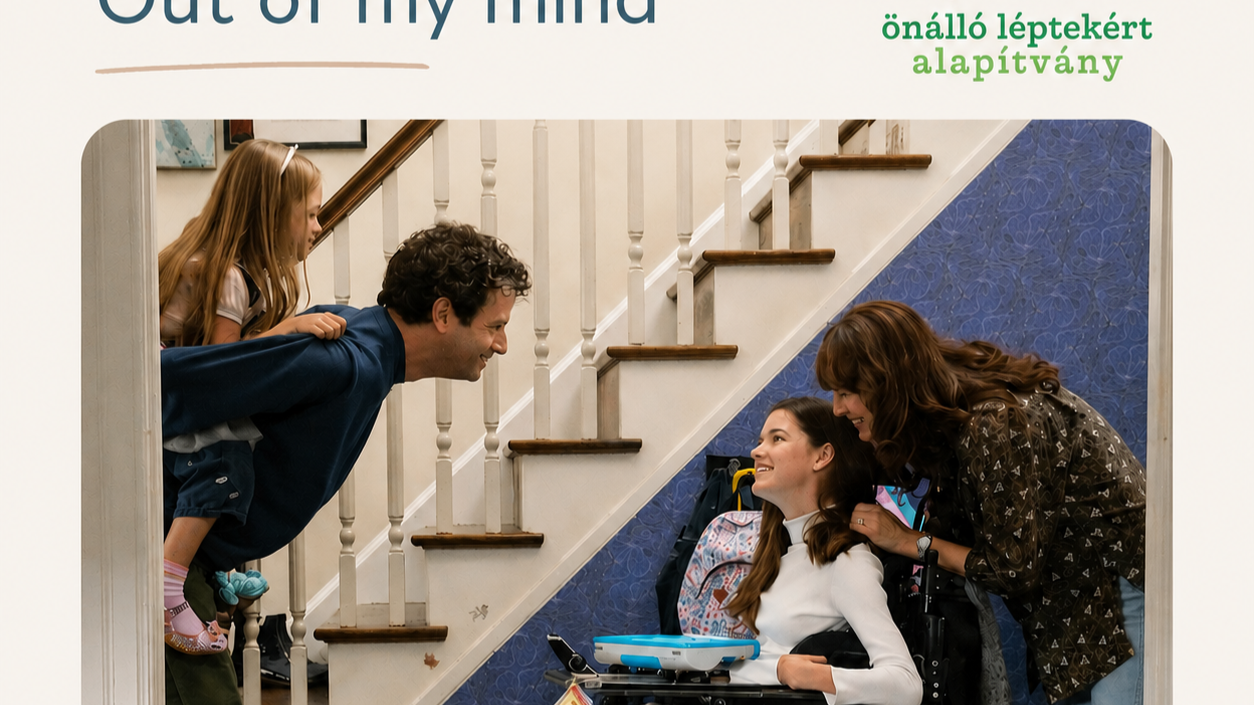
Out of My Mind (2024) is a Disney+ original film based on Sharon M. Draper's international bestselling novel of the same name. Directed by Amber Sealey with a screenplay by Daniel Stiepleman, it premiered on Disney+ on November 22, 2024 — where it is also available in Hungary with a subscription.
The story centers on Melody Brooks, a sixth-grade girl with cerebral palsy: she cannot speak and uses a wheelchair, yet she has a sharp mind, a photographic memory, and an extraordinarily rich inner world. For a long time, the people around her — her teachers, her classmates, sometimes even her own family — judge her by what she cannot show of herself: her movement, her speech. When a young teacher recognizes the talent within her and Melody joins the mainstream curriculum, the film unpacks exactly what its title promises: that what someone says matters far more than how they say it.
One of the film's boldest directorial choices is that Melody's inner voice — her thoughts, her humor, her anger, her joy — is voiced by Jennifer Aniston. This is no gimmick: it literally lets the viewer into the mind of a non-speaking child, offering a perspective we rarely get in everyday life. The film debuted at the 2024 Sundance Film Festival and went on to win a Peabody Award, with critics highlighting how it manages to sidestep the trap of so-called "inspiration porn" — it doesn't try to move us by casting its disabled protagonist as automatically heroic, but by building a real, authentic character.
Why this matters to us, parents raising children with CP
Raising a child living with cerebral palsy means confronting, day after day, the fact that most of the world judges by speech, by movement, by "typical" behavior. Out of My Mind shines a light into exactly this blind spot. It shows that inside the mind of a non-speaking child there can be a world of thought just as rich, complex, funny, and sensitive as anyone else's — it simply reaches us through different channels, or doesn't reach us at all if we fail to offer enough attention and the right tools.
One mother's reflection: "For me, this film was a genuine eye-opener. Not because it told me anything new about my child having an inner world as rich as any of her peers — as a parent, I knew that, of course — but because we so rarely get such a direct, cinematic glimpse of what all this might look like from the inside. It reaffirmed what I feel every single day: children with CP are exactly like any other kid — only the path of communication is different."
The film struck a familiar chord in another way as well. It shows how the system — whether school, healthcare, or social services — almost always looks for the simpler, more convenient path. Not out of malice, but because individualized attention, genuine integration, and providing the right tools demand resources, energy, and commitment. As a result, parents very often have to fight hard battles to secure the education, help, and support that truly fits their child.
What is especially sobering: all of this takes place in — and holds true for — the United States, a country where cerebral palsy is well known, well researched, and lived by many families. If securing the right support is such a struggle even there, how much harder must it be in Hungary, where many people have never even heard of CP, let alone understood its everyday reality.
Why we recommend it to others
This film has something to offer in three directions.
For parents of children with CP, it offers reassurance that we are not alone in the battles we fight — with the system, with institutions, sometimes with our own surroundings — so that our child gets a chance. And it reaffirms that our child is exactly like any other child — they simply communicate differently.
To children and young people living with CP, it says that they are not defined by their movement or their speech — but by their thoughts, their humor, their personality. That they are immeasurably cool, exactly as they are.
And for everyone else — teachers, healthcare professionals, or simply anyone who wants to better understand the world of people living with disabilities — it offers a rare, authentic, cinematically crafted view from inside the mind of a non-speaking child.
Out of My Mind is available to stream in Hungary with a Disney+ subscription. If you have the chance, it is well worth watching — and if there is a child or adult living with CP in your life, it is worth watching together with them.
Sources and further reading:
· Out of My Mind (film) – Wikipedia
„Cerebral palsy is not something to be ashamed of. It is not a tragedy. It is a journey — and no one should walk it alone.”
Every single forint brings a child with CP one step closer to setting out in life on their own. Thank you!